The Big Picture: Ilmor Marches On
A Michigan company has succeeded where other substantial engine manufacturers have failed - in production high-performance.
December 21, 2009
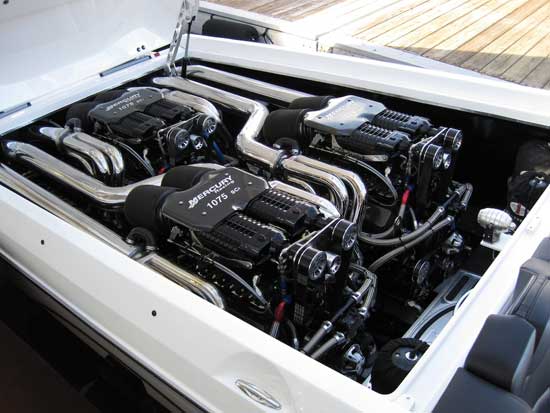
From Chief Engines in Florida to Teague Custom Marine in California—and Michigan-based Sterling Performance smack-dab in the middle—there are dozens of high-quality, high-performance marine engine builders across the country. And yet none of them could be called a production builder capable of high output while retaining the highest quality. That distinction has long belonged, and for the most part still belongs, to Mercury Racing in Fond Du Lac, Wisc.
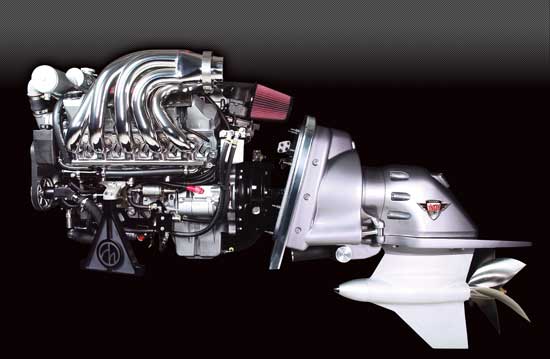
A 725 hp engine from Ilmor with an Ilmor Indy drive.
I say “for the most part” because although Ilmor Marine—a division of Ilmor Engineering in Michigan—has had tremendous success with its line of V-10 engines since entering the market in 2004, its production still represents a fraction of that of Mercury Racing. With 550-, 650- and 725-hp engines, as well as its Indy stern drive, the Ilmor product line also is far more limited than Mercury Racing’s line, which includes 525-, 600-, 700-, 850-, 1,025-, 1075- and 1,200-hp engine and other products such as the No 6 Dry Sump drive and K-plane trim tabs.
Still, Ilmor has made significant progress in the high-performance marine engine game. The company has succeeded in a market where other substantial engine companies, most notably Volvo Penta—and Volvo Penta’s high-performance engines are solid products—have failed.
Ilmor had a couple of advantages over other would-be players in the production—as opposed to custom—high-performance engine game. First, the company came to the marine engine market with a legacy of engineering and engine building success in Formula One, Indy car and NASCAR automobile racing.
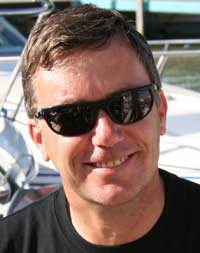
Paul Ray, president of Ilmor Engineering
“We are a true high-performance company—high-performance is our core industry,” says Paul Ray, president of Ilmor Engineering. “Ilmor started as a racing company. Everything we’ve ever done has been about high-performance. We’ve stood behind that for 25 years, so we when we tell that story to our engine buyers they believe us. We’ve never had a credibility barrier to cross in convincing people that we are a capable high-performance company. We are a high-performance company to our very core.
“The second part of it (success in the high-performance marine engine market) is really sticking to it and being flexible enough, and small enough, to make changes when necessary. We really stood behind our product in every way we could and made sure our customers were happy. Some of it is just the way we conduct our business.”
Some of Ilmor’s success also could be credited to its exotic engine platform. During 2001 and 2002, when Ilmor started looking into high-performance marine development, the company also was doing oiling-system work on the Dodge Viper V-10 engine from Daimler-Chrysler. At one point, the company actually had a Viper V-10 engine in one dynamometer cell and a Super Cat offshore racing engine in a dyno cell down the hall.
“We were in this engineering review meeting looking at the APBA Super Cat engine and the Viper V-10,” says Ray. “Looking at the torque curve and the size of Viper engine compared to the Super Cat engine, we could that the Viper had quite good potential as a marine engine.
“We did our research and looking at the marketplace we saw it was full of GM engines,” he continues. “We said, ‘Why don’t we do something different?’ So we approached Daimler-Chrysler and the rest is history.”
From their first dyno test, the engineers at Ilmor could see the Viper V-10 made 500 hp without straining. So through conservative tuning they upped its output to 550 hp and marinized it. Using the same platform with different tuning and some internal components, they produced 625- and 710-hp models, which in 2009 were upped to 650- and 725-hp versions. In earler 2009, the company unveiled its Indy stern-drive, the first non-Mercury, production built stern-drive (not to be confused with a shaft drive from Arneson, Buzzi or BPM) rated to handle more than 700 hp.
Yet product development has been the lowest hurdle from Ilmor since 2007, a year in which somewhere between 2,200 and 2,400 high-performance marine engines of 500 hp or more were sold. The biggest challenges facing the company have been Environmental Protection Agency, California Air Resources Board and European Union emissions, and the domestic and international economy.
“In 2007, we sold about 200 engine units, which puts us at about 10 percent of the market at that time,” says Ray. “We were looking at building more powerful engines in the 900-hp range, and to do that you have to look at supercharging. Then the EPA and CARB came along with their new rules, and we had to turn our focus to emissions compliance. Now that we have all our engines in compliance, we can go back and start looking at bigger power again, but it’s hard to justify that in this economy.
“Finding customers, that is truly the greatest challenge,” Ray continues. “Until the credit market eases and the banks start lending money, and they will, high-performance boat sales are going to be greatly impacted. Credit will ease in the next two years as the banks find their feet gain. I think the worrying thing for us is if the market will ever get back to where it was.”
Regardless of how the performance-boat landscape looks when the economy turns, Ray says Ilmor will be in the game.
“We made a commitment in 2003 to get in for the long haul and be a big player,” he says. “We will continue along that path, only slowed by the economy.”